

Variable source water
The ingredient you rarely measure
Tap and filtered water can shift by place, season, and treatment. The same coffee and recipe can taste different before you change a single brew variable.
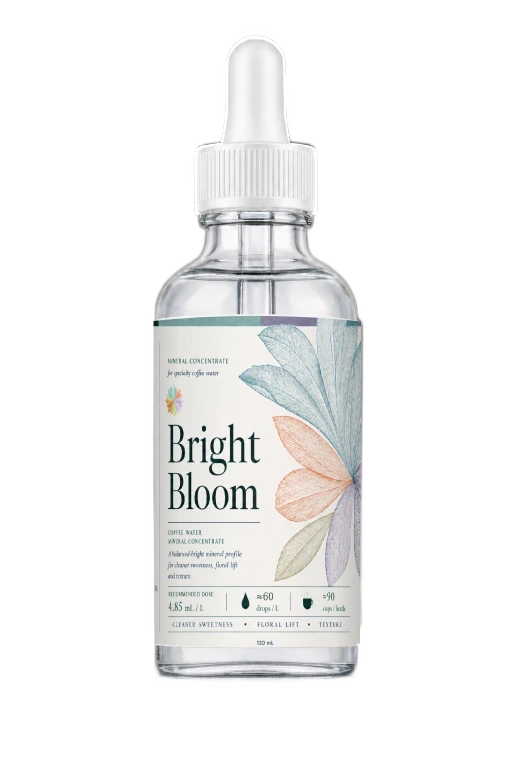
More than 98% of brewed coffee is water. Give it the care it deserves. Bright Bloom makes distilled or high-purity RO water ready for repeatable brewing, one measured dose at a time.
S$35 single · S$50 pair (S$25 each)
Calculate a dose120 mL
Concentrate
60 to 120
Reference ppm range
80 ppm
Recommended start
4.85 mL
Per litre at 80 ppm
~24.7 L
Per bottle at 80 ppm
Why coffee water matters
98%
More than 98% of brewed coffee is water. That makes water the largest ingredient in every cup and one of the easiest variables to standardise.
Variable source water
Tap and filtered water can shift by place, season, and treatment. The same coffee and recipe can taste different before you change a single brew variable.
A clean starting point
Distilled, demineralised, or high-purity RO water removes the unknowns. It is flat on its own, but it gives a mineral recipe somewhere repeatable to begin.
A designed profile
Bright Bloom adds a consistent balance of hardness, alkalinity, and supporting ions to create a foundation for clear, expressive coffee.
A TDS number describes total dissolved material, not which minerals are present. For the intended profile, start with water that is already close to mineral-free.
Sensory profile
01 / 06
The profile is formulated to help fruit-led acidity feel vivid and articulate, particularly in lighter roasts.
A simple brew ritual
Bright Bloom is calibrated for distilled, demineralised, or high-purity RO water at or near zero TDS. Choose a reference strength or enter a custom target, with 80 ppm as the recommended starting point.
01
Gently redistribute the concentrated minerals before every use.
02
Choose a 60 to 120 ppm profile. Start at 80 ppm, or 4.85 mL per litre.
03
Mix thoroughly, then use the prepared water in your normal coffee recipe.
Dose calculator
Choose a preset or custom ppm target, then select a common batch size or enter 0.1 L to 20 L.
Water volume
Use the prepared water after mixing thoroughly.
Your Bright Bloom dose
7.28mL
For 1.5 L at 80 ppm (recommended)
4.85 mL per litre, approximately 90 drops for this batch.
Cup estimates allow 275 mL of prepared water for each 250 mL serving. Drop estimates use the observed 90-drop dose for 1.5 L at 80 ppm: approximately 0.081 mL per drop, or 12.4 drops per mL. Actual drops vary, so use mL for primary dosing.
Designed ion by ion
See the nominal strength of every listed ion and the function it serves in the formula. Rows follow the blend's design architecture, not descending mg/L.
Bright Bloom uses one fixed ion balance at every strength. These cards explain why that balance was chosen, while the exact calculations remain available below.
Recommended starting point. All seven ions increase together while their balance stays fixed.
Magnesium supplies about 88% of the magnesium-plus-calcium hardness calculation. We use it as the leading sensory ion for a vivid profile, while calcium remains supporting for structure and concentrate stability. This is formula architecture, not a universal optimum.
At this strength, calculated alkalinity is 9.0 mg/L as CaCO₃. Across Bright Bloom's 60 to 120 ppm dosing range, it rises from 6.7 to 13.4 mg/L as CaCO₃. This keeps bicarbonate buffering deliberately limited, with the intent of softening sharpness without heavily neutralising the coffee's acidity.
The ion table reports each ion's own mass concentration. Hardness and alkalinity use calcium-carbonate equivalents, so they cannot be found by directly adding the ion-table values.
Magnesium is deliberately the leading hardness ion and calcium is deliberately secondary. Their fixed mass ratio is 4.45:1, which becomes 88.01% magnesium-derived on the CaCO₃ hardness scale. This supports Bright Bloom's intended lively sensory direction while retaining some calcium structure. Keeping calcium low also reduces, but does not eliminate, calcium-bicarbonate and calcium-sulfate precipitation pressure in a single-bottle concentrate.
Bicarbonate neutralises coffee acids. Bright Bloom therefore uses a low but non-zero amount: enough to provide some resistance to sharp acidity, while deliberately limiting how much of the coffee's acidity the water can neutralise. The preferred balance still depends on the coffee and brew method. The exact level is Bright Bloom's formulation choice, not a literature-defined optimum.
These are formula-derived estimates, not laboratory measurements. The hardness factors match the EPA hardness equation. The alkalinity conversion follows equivalent-weight accounting consistent with the USGS alkalinity method, using conventional atomic weights within the CIAAW standard ranges. Coffee-specific context comes from the 2014 cation model, its 2024 experimental follow-up, the SCA discussion of alkalinity, and the APAX LAB evidence framing.
| Ion | At 80 ppm | Mass shareof listed ions | Formula role | Chemistry and intent |
|---|---|---|---|---|
| Magnesium (Mg²⁺) | 12.14 mg/L | 15.17% | Hardness lead | The primary contributor to calculated hardness, supplying about 88% at every strength.Design intent: Chosen as the leading hardness ion for a lively, bright target profile. |
| Bicarbonate (HCO₃⁻) | 10.92 mg/L | 13.64% | Acid balance | Sets the formula's alkalinity and buffers coffee acids.Design intent: Kept restrained to moderate acidity without flattening the cup. |
| Chloride (Cl⁻) | 37.84 mg/L | 47.30% | Roundness | A major non-buffering anion that contributes to charge balance and ionic strength.Design intent: Used prominently in pursuit of a rounded, smooth presentation. |
| Sulfate (SO₄²⁻) | 8.50 mg/L | 10.63% | Floral lift | A divalent non-buffering anion that contributes to charge balance and ionic strength.Design intent: Kept supportive in pursuit of floral lift without excess dryness. |
| Sodium (Na⁺) | 4.85 mg/L | 6.07% | Flavour accent | A monovalent cation that does not contribute hardness or alkalinity.Design intent: Used as a measured flavour accent and kept below the main profile ions. |
| Potassium (K⁺) | 3.03 mg/L | 3.79% | Finish support | A monovalent cation that does not contribute hardness or alkalinity.Design intent: Included in pursuit of gentle fullness and a lingering finish. |
| Calcium (Ca²⁺) | 2.73 mg/L | 3.41% | Subtle hardness | A secondary hardness ion, supplying about 12% of calculated hardness at every strength.Design intent: Kept deliberately subtle as part of the intended structure and texture. |
| Total listed ions | 80.00 mg/L | 100.00% | Combined profile | Nominal target before meter conversion and rounding. |
Reading mass share. This is each ion's percentage of the listed-ion mass total: a normalized fingerprint of the formula, not its percentage contribution to hardness, alkalinity, charge balance, extraction, or flavour. At the 100 ppm preset, the percentage is numerically equal to the mg/L value; the proportions remain fixed at every strength.
Formula role describes Bright Bloom's design intent. It is not a concentration ranking, quality score, or claim that one ion independently causes a specific flavour. Chemistry describes established water behaviour; tasting intent describes how the blend was designed. Values are theoretical from ingredient masses and stated purities. In dilute prepared water, mg/L is approximately equivalent to ppm. Independently rounded concentration and mass-share rows may differ from their totals by 0.01, and a conductivity-based TDS meter may display another value.
Nothing hidden
Every mineral salt, purity specification, and amount in the final 120 mL coffee water concentrate is published below.
| Ingredient | Formula | Purity | In 120 mL |
|---|---|---|---|
| Magnesium chloride hexahydrate | MgCl₂·6H₂O | >98.0% | 2.107 g |
| Magnesium sulphate heptahydrate | MgSO₄·7H₂O | 99.5% | 0.542 g |
| Calcium chloride hexahydrate | CaCl₂·6H₂O | >97% | 0.380 g |
| Sodium hydrogen carbonate | NaHCO₃ | 99.0% | 0.250 g |
| Potassium bicarbonate | KHCO₃ | 99.9% | 0.148 g |
| Sodium chloride | NaCl | 99.9% | 0.133 g |
| Potassium chloride | KCl | >99% | 0.033 g |
| Distilled water | H₂O | 100% | q.s. to 120.0 mL |
The weighed-salt figure includes water of crystallisation in the hydrated salts. The listed-ion sum is derived stoichiometrically from the weighed salts and stated purities, using the stated threshold for ingredients specified as greater than a given purity. This ion sum drives every preset and custom dose calculation. Neither concentrate figure predicts an exact conductivity-meter reading.
Where it works
The 60 to 120 ppm reference range is designed for pour-over, drip, batch brew, and immersion methods, with a particular affinity for light and light-medium roasts.
Prepare the water outside the machine and confirm that the resulting hardness and alkalinity meet your equipment manufacturer's requirements before filling a reservoir.
Bright Bloom can be explored at a lower dose for tea. Begin gently and adjust by taste, since delicate teas often suit softer water than the standard coffee recipe.
Coffee water guides
Coffee Finder by Bright Bloom
A taste-led specialty coffee field guide
Use Coffee Finder to discover carefully selected coffee shops and compare cup-first reviews for pour-over, espresso, black, and white coffee across Asia.
Questions, answered
